Monday, January 14, 2008
Christmas Loaves

Wednesday, January 02, 2008
Mano de Dios
It's not like I'm a complete slacker, though. Whilst away, I dedicated my creative energy to solving the backyard pizzaiolo's table-space dilemma.
This handy table-top device, which I modestly refer to as the "Mano de Dios," is constructed of cheap plywood and 1 x 2 boards cut and and assembled to mimic the functionality of the classic "sheet tray rack" ubiquitous in all baking establishments. I say "mimic" in the loosest sense because, make no mistake, this invention is (1) novel, (2) non-obvious and literally bursting with (3) industrial application (which, I think, just happen to be the three legal elements of patentability).
There are several accepted methods for using "the Mano." Pictured below is the classic technique known as the "Give 'n Go." Here the Pizzaiolo (me) stretches the doughs, places them on the floured boards and slides them into the Mano. Meanwhile the Pizzaiolo's assistant sometimes referred to as "Diego" (actually, here, Zencamel) prepares the doughs for the oven and returns them to the Mano where they await final placement in the oven by the Pizzaiolo.
If the Mano de Dios looks like something that might work for you, too bad. There's only one.
Thursday, August 16, 2007
Pizza Adventures in Maine
Deep at the core of my being, I know that Richmond is ready for such an establishment. But who shall bring it to us?
Friday, August 10, 2007
The BackBou gets a little media coverage...
Tuesday, July 31, 2007
The Second Layer
We begin with more mixing. This time we are mixing true cob -- a mixture of Virginia red earth, sand, straw and water. Because I had some powdered Red Art clay on hand and little left over coarse grog from the first layer, I added it as well.
I learned an important lesson about oven-building collaboration. While these projects are great fun for the kids, adult helpers can actually make the project go faster and provide good company. In this session, I was particularly lucky to have two helpers with great attitudes and actual experience in working with clay. In the future, I shall encourage more adult collaboration in my oven building activities.
Here, Mr. J does the cobbers' high step with me.
We laid the cob "bricks" in courses around the first layer. The trick is to proceed as though you are truly building one course on top of another, merely using the existing dome as a guide. Note how pressure is applied down and not inward toward the dome.
We mixed two large batches of cob and one tiny one just at the end because -- of course - we were a two bricks shy. Here, Ms. J and I put the last bits of cob in place.
The last order of business was to smooth the outside of the second layer using hands and a rocking motion with a flat board.
After drying out, which takes at least a few days, the oven is functional. However, a final layer of adobe plaster makes the exterior a little more presentable by, among other things, hiding the straw pieces. Next update will include photos of the "plastered" end product.
Tuesday, July 03, 2007
Il Duomo
I dry-stacked a firebrick door frame using angle irons (as suggested by Kiko Denzer). I really wanted to make the entrance point of the oven a little more civilized this time.
I've been dying to try a little brick masonry and this seemed to give the dry-stacked firebrick arch a little extra support. I am hoping the mortar will be insulated from the most intense heat so that it will not degrade too rapidly -- even if it does, it won't seriously undermine the structural integrity of the oven. The paving bricks are stacked in the center to hold in place a piece of drywall that will prevent the sand form from spilling through the door.
We spent a surprisingly long time forming the sand mound. Kiko cautions that the form should rise very steeply and then round off gently at the top. For some reason, the temptation is to build a pointy form, which makes for a poorly shaped oven. He says to aspire to a pregnant belly shape, which is probably why it took me so long. Try though I did, my best effort was still a pretty scary looking pregnancy.
Once you sculpt a beautiful sand form, you promptly cover it up with ugly wet newspaper. Mine declared the immigration bill defeated. This helps form a clean break between the sand form and clay to facilitate removal of the sand.
We mixed dry clay and grog -- this is where I part company with purists like Kiko Denzer. I used one part Redart Clay, one part Hawthorne Fire Clay, one part 35 mesh grog and one part course grog that the ceramic supply store had lying around and didn't know what to do with. I measured the "parts" by volume not by weight. In the end I used 100 pounds of Hawthorne, about 85 pounds of Redart and 175 pounds of grog. Kiko uses earth and sand. After adding water and mixing with our feet, we formed wet bricks.
McGee, desperate to be a part of the process, kept dropping his tennis balls into the clay mixture.
We encased the sand form with the wet clay. I made two larges batches of clay -- which ended up being about three bricks short (not reflected in the photo below - which was more like the halfway point). This was very frustrating. I made a third small batch of clay to top off the crown.
Once formed, I scored the sides with a trowel so that the next layer would have something to grip to.
Friday, June 22, 2007
Demolition Complete; Rebuild Begins
The demolition is complete. Assistance was had by two laborers with demonstrated skills in destruction.
I was impressed by the integrity of the inner layer (pictured below) and the outer layer (long gone in this photo). Curiously the middle layer (pictured above) -- which should have been the structurally most sound - was very crumbly.
Look how uneven my oven floor had become. The sand beneath the bricks sifted through the gravel bed and caused the floor to cave. This had been a constant headache for me in the early months after the oven build. I had to remove the bricks and relay gravel and sand, but it was impossible to make it level after the oven structure was in place. For the latter years of the oven, I lived with an uneven floor. Remarkably, it did not seem to matter as much as you might think. Nevertheless, I have vowed not to let this happen again. This time I will lay a bed of concrete for the sand to sit on.
The rebuild has begun. I added a course of stones to the base and added crushed adobe from the demolition as extra fill.
Friday, May 11, 2007
Rebuild?


Monday, March 19, 2007
Malt-O-Meal
I had acquired a sports stop watch believing somehow that the simple act of timing contractions was going to be a task of near impossible complexity under the crushing stress of labor. After all, it did involve math. Gazing out at the quiet calm of our sleepy city neighborhood and listening to Ann’s softly uttered signals, I realized for the first time that the bright yellow stop watch was an acquisition fueled by anxiety. I had imagined myself hunkered down by the side of the bed gripping the stop watch with white knuckles as limbs thrashed on the bed tearing covers and frightening small furry critters nestled in giant pin oak outside our bedroom window. In my mind, I would be splattered with blood and saliva and god knows what else. It would be war. I chuckled at the ridiculous gleaming stop watch and lay back in bed completely unaware that my impression had not been that far off.
I logged on to my firm’s network and took advantage of the once in a lifetime opportunity to cash in on the valuable capital that a person has on the eve of their first child’s birth. “Dear Manager: Wife’s in labor and anything could happen in any minute. Please take care of all my deadlines.”
Smugly, I put the laptop away and poked around the kitchen. The culinary considerations were complex. I knew that Ann would be working hard. She would need energy. On the other hand, I had heard that labor could induce vomiting. I also knew that Ann was especially finicky at this point. With these thoughts in mind, I lined up some possibilities. An obvious choice was Pasta. Ann is half Italian and pasta is comfort food but then I envisioned regurgitated red sauce splattered on stark white hospital linens about to welcome my precious child into the world. I imagined her first breath fouled by the pungent smell of stomach acid mixed with sheep’s milk pecorino Romano, which, come to think of it, already had faint overtones of vomit. She could be forever predisposed against pasta and red sauce, an important identity peg for her mother. Worst case scenario, Ann would reject her as insufficiently Italian because she would never overcome her utter disgust over pasta and red sauce. It was pushing 3:00 a.m. and I wasted 10 minutes. Cold cereal with soy milk seemed too cold for blustery winter night. Eggs were stricken based on taste parameters alone. Finally, I stumbled on a box of Malt-O-Meal that my uncle in Minneapolis had sent as part of a gag Midwestern care package. This seemed perfect and I liked the idea of my child coming into this world under fuel of something as wholesome and Midwestern as Malt-O-Meal. In some way, this was my very first act of parenthood and that it was well-received was immensely satisfying to me.
For a short while, I would feel composed and confident, but that feeling (through no fault of the Malt-O-Meal) would not last long ...
Tuesday, February 20, 2007
Future of Food
The film has an agenda, namely to promote what they term "sustainable agriculture" and to disparage the corporations and government regulators that promote industrial farming. It is, however, a very compelling look at, among other things, the frightening loss of crop diversity in American and increasingly in international farming. This loss of diversity is not only a travesty for culinary enthusiasts but also a palpable risk to our food supply.
Also very interesting is the film's coverage of the ruthless tactics that corporations such as Monsanto have employed to exert control over the marketplace by enforcing patents on their genetically modified seeds. The interesting thing about patenting life is that life, unlike, say, a toaster, replicates and spreads. Thus, according to the film, Monsanto's patented genes have found there way into unsuspecting farmer's crops after which Monsanto has had the unmitigated audacity to sue for patent infringement. Using these tactics, Monsanto has, again, according to the film, pressured farmers (who never actually purchased Monsanto seed stock in the first place) into agreeing not to save their own seeds, thereby ensuring the sale of Monsanto seeds. If these farmers are to be believed, this is akin to breaking into cars, installing your own patented stick shift, and then suing the owners for patent infringement.
Monday, January 29, 2007
Ice Cream for Your Health
Wednesday, December 20, 2006
Churning thoughts of restless mind

Hmmm it’s a conundrum. If I see a person in terrible pain, I experience anguish which inspires compassion. Intellectually, though, I know that this suffering occurs around me all the time. Since I know this, why shouldn’t I be constantly plagued with such anguish? Maybe I am. I kinda feel that way right now...
But here is another take. This entire discussion assumes that minimizing human suffering is the “Right Thing To Do.” Presumably we can all agree that we are all humans and that experiencing a sort of constant anguish because of an awareness of suffering in the world is itself a form of human suffering. Pretty clever, huh? Thus, perhaps the ability to insulate ourselves from this despair is something we ought to celebrate as a tool that has the happy result of minimizing net human suffering. It is hard to feel good about this line of thinking so long as you are thinking in terms of insulating yourself from feeling anguish about the pain others experience, but turn the tables for a minute. Assume that you’re the one experiencing some unjustifiable terrible pain. Most of would consider it a blessing if we could find a way to protect, say, our children from witnessing and despairing because of our own pain.
But it seems hard to celebrate this gift of denial because one tends to think that if humans do not despair at their fellow creatures' suffering they are not apt to do a damn thing about it -- heck I do despair and I barely do a damn thing about it. As mentioned above, what little compassion I can muster seems to emanate from a sense of distress generated from others' suffering. But here’s the thing: perhaps one should be able to cultivate that compassion on its own for its own sake without having it be the product of your own anguish, despair etc. Aha! (Maybe everyone else can already do this and its just me...)
I am not sure but I think all of this leads me to the simple conclusion that we would all be best off if we could cultivate the ability to not despair at others' suffering (i.e. what I was calling the ability to “deny” above) and at the same time nurture the instinct to be compassionate to our fellow creatures nevertheless. This would seem to have the positive effect of minimizing net human suffering (allowing ourselves not dissolve into puddles of despair) without stripping us of the motivation to ameliorate the suffering of our fellow creatures.
I’ve always wondered about reconciling the Buddhist notion of nonattachment with its celebration of compassion. They seem in conflict but I think the exercise above gets me a little closer to understanding. In other words, there is no value in being so attached to this world that your awareness of the world causes you distress. Indeed, shunning attachment fosters a net reduction of suffering in the world so long as – and this is the big one – so long as you nurture compassion for your fellow creatures. The compassion component is really important to balance out the nonattachment. Huh, I've never really seen it this way! I'll probably forget about it in the morning, though. Maybe I've forgotten it a bunch times... Nah...
Now I can sleep, anyway. I bet you're already there....
Wednesday, November 15, 2006
For The Love of Spoilage
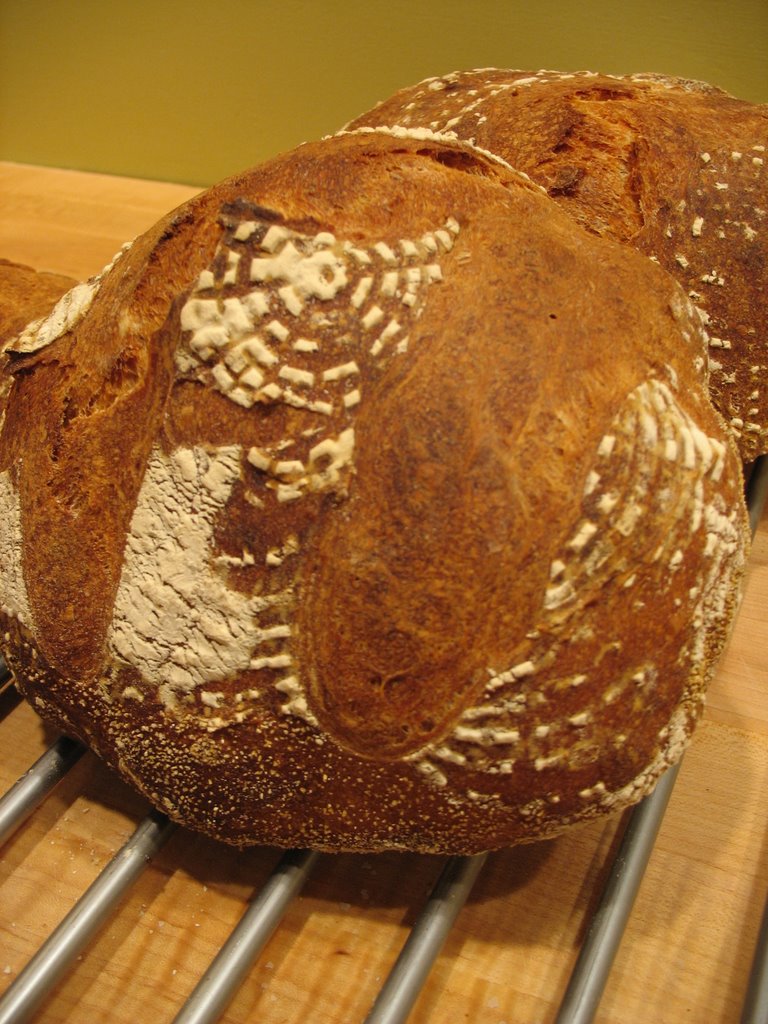
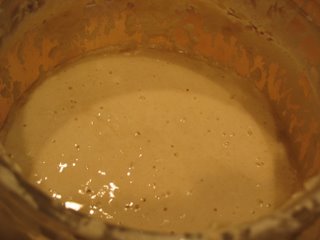
This is a pretty nice loaf, eh? The color is dark, it has a clever design from the proofing basket and the shape suggests a vigorous oven spring. You can't tell from looking at it, but its interior was nothing to scoff at either. And, so long as we are not being modest, the flavor was first class -- complex and sour with an aftertaste that lingered for at least of quarter of an hour (I'm not kidding about the after taste -- its a curious thing about real sour dough.) While the key to the loaf's appearance is probably the adobe oven, the key to the flavor is the living beast pictured below -- my starter -- a frothing colony of hungry bacteria and yeast that thrives until it can't tolerate its own excreta any more.
Its an interesting observation, I think, that many of the foods about which we obsess the most involve a culture or a fermentation -- think wine, spirits, cheese (and sourdough). Part of it is the complexity of the resulting taste, but part of it also, I think, is primal. There is something darkly appealing about a delicious flavor that flirts with the taste of spoilage. How else can one account for the beloved french cheeses such as morbier, which have distinct overtones of toenail clippings and dead animals.My well-researched and scientifically-supported theory suggests this results from natural selection. The BackBou and his team of dedicated research assistants postulate that a preference for the spoiled-food-that-won't-kill-you is evolutionarily selected for. Back in the day, pretty much everything was spoiled (this is fact). If it wasn't spoiled when you found it, it sure as heck was spoiled shortly thereafter. Finicky humans who couldn't stomach the taste of spoiled stuff died out -- except for the people who settled Iowa. Most of the folks whose palates couldn't distinguish between the deadly vs. edible spoiled food also pretty much died out, though enough of those unrefined palates lived on to support, for example, the deadly American fast food industry. That left the rest of us. Now, not everyone has awakened his or her inner love for the benevolent spoiled foods, but rest assured it lingers somewhere in all of us.
Monday, September 18, 2006
Homage to 'Cakes
Honestly, now, consider the pancake. Humble but proud, the pancake was born of rustic griddles and coarse-milled grains but passes effortlessly into the uptight company of creme fraiche, fancy berries and bad coffee in silver service. When I was child, my mother made fine buttery pancakes on most weekend morns. So dedicated was my family, that when we were unable to acquire even imitation maple syrup in our home of central Africa, we made do with homemade sugar syrup flavored with maple extract. The 'cakes were still good.
The virtues of the pancake are so many they defy listing. Inexpensive and easy to make, they taste rich and complicated. They can be made healthy and nutritious or decadent and fattening. My rule of thumb is two cups of flour (plus salt, baking powder, sugar) to two cups of wet stuff. The wet stuff can be comprised of a great variety of things including but not limited to eggs, milk, butter, oil, apple sauce, apple butter, soy milk, buttermilk, goat milk, cream, or yogurt. I literally take my Pyrex 2 cup measure and start filling it up with what I have around. The results vary but are usually quite good.
Many people believe that buying a pancake mix is a good idea. It is not. They are very mistaken. Pancakes from mixes are not easier to make, they are not as tasty, are more expensive and probably less healthy. So lets see .... They are fun to make, fun to eat, cheap, healthy (or not), oh yeah and generally good for the family. Children love to assist in all aspects of the pancake ritual which, of course, translates into a "teaching moment." What is not eaten at breakfast, becomes the kids' afternoon snack to be gobbled down amidst inquiring glances and raised eyebrows at the park.

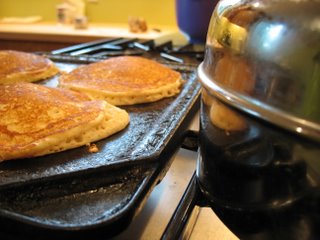
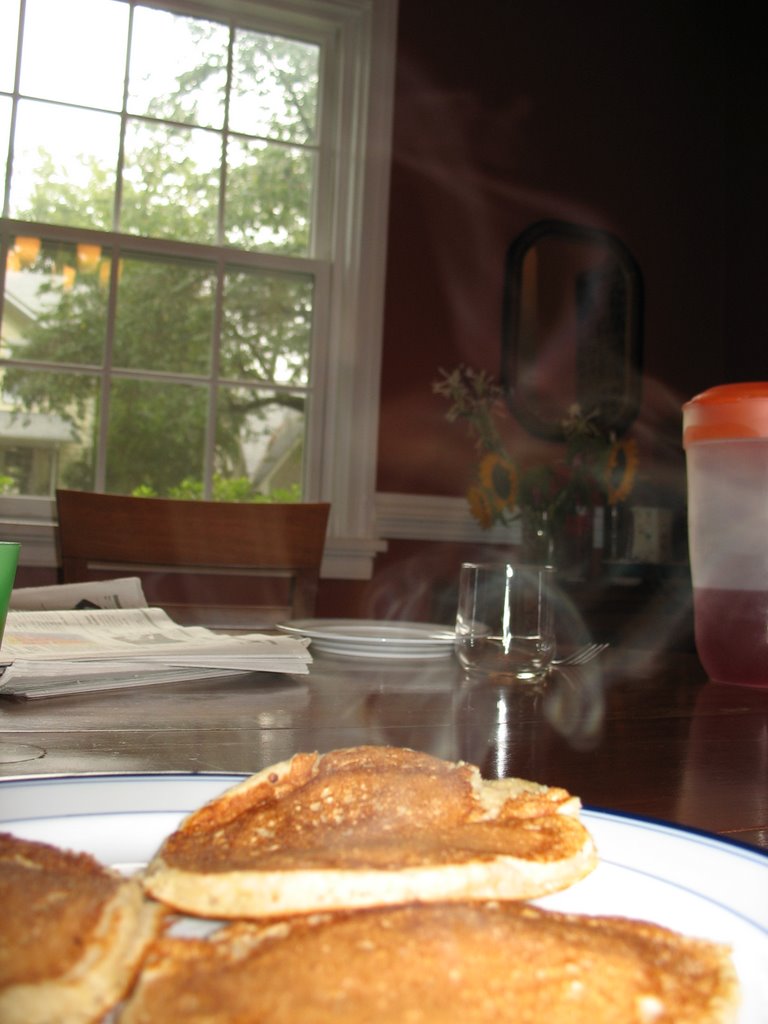
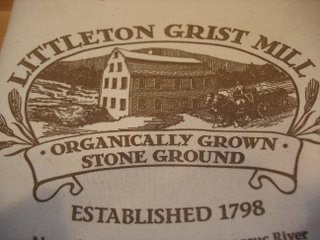
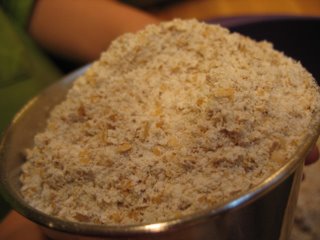
Thus, when ZenCamel delivered to us one bag of stone-ground organic wheat flour (with germ) from the Littleton, NH Grist Mill, it was not long before my family turned to making pancakes. The results were superb -- a delicate 'cake with a hearty whole-wheat flavor punctuated by nutty bits of wheat germ.

Thank you Mr. Camel.
Friday, September 01, 2006
Taste of the Valley

Anyway, back to the pizza ... this festival oven is, I think, a semi-permanent fixture at the Round Barn because American Flatbread caters so many weddings and other events at the Inn. But George and his crew can also set one of these ovens up in an afternoon. They arrive with rough hewn wooden logs to build a sort of lincoln-log platform on top of which, as I recall, they create something like a big sandbox. They lay fire bricks in the sand for a floor and then they stack bricks in diminishing concentric circles, which they plaster with cob (mud and straw). Typically, they use the festival ovens just to finish par-baked pizzas on site. It may sound like cheating, but keep in mind that the pizza is par-baked in an earth and stone Quebec style oven. Trust me, the product is good. I recall a pizza topped with a basil and sunflower seed pesto. It was good enough that I made a mental note to experiment with it, though I haven't yet. There was also a very memorable Vermont sausage pizza.
It was a nice event, though the limitations of my stomach capacity were frustrating. There was plenty more good eating to be had that night...
Tuesday, August 22, 2006
The Curious Incident of the Backpack

So last week I arrive at work, park my car and proceed towards my building when I see this guy standing in the middle of parking lot staring with a look of utter disbelief at a backpack lying about five feet in front of him in a traffic lane. It's early but this registers as odd. I proceed with caution envisioning corporate security squealing onto the scene in an armored golf cart to unleash a barrage of automatic weapon fire at the suspicious bag. But it's not that early and I recognize this as highly unlikely. I approach the man. Nearby a car in a different lane slows down for a look. The man looks at me, shakes his fist in the air and in a deep voice with a thick Russian accent proclaims loudly, "eez thurd day een row ... bee has landed on bakpak!."
"Oh how very curious," I say, thinking to myself that the curious part had little to with the bee.
Monday, August 14, 2006
Pizza Pilgrimage
Last week we made our annual pizza pilgrimage. Every pizza I make aspires to the perfection of George Schenck's "American Flatbread." Not the frozen ones at supermarket in his signature black and white boxes -- though those are good too -- but ones like I sampled last week (pictured above) fresh from his modified Quebec style oven (pictured below) in the Mad River Valley of Vermont.
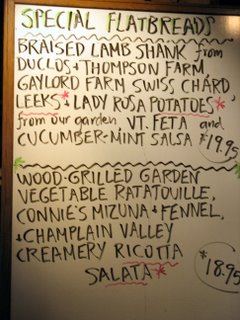
On our visit last week, we sampled the veggie special:

Look at that thing! You can almost taste the smoky overtones of the wood grilled ratatouille "sauce" mingling at the back of your mouth with the clean flavor of the fennel -- interrupted for a second by a soft creaminess that is the ricotta salata. Sometimes, all is right with the world -- even if just for a fleeting moment.
Thursday, August 03, 2006
The Thing About Naked People

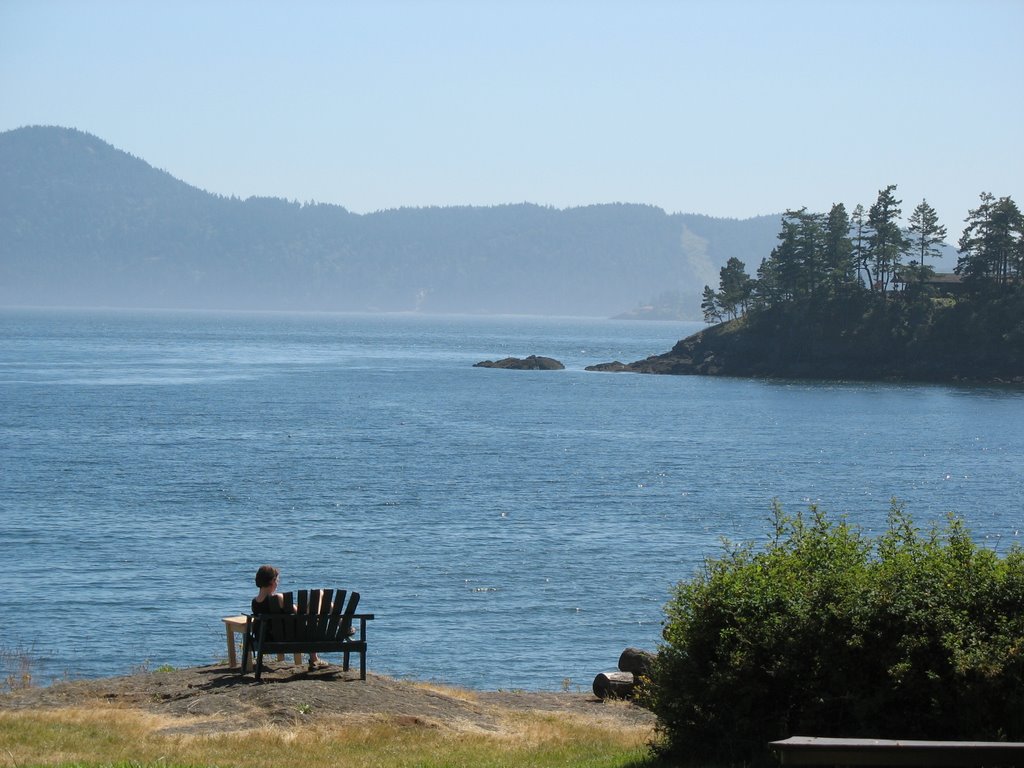
I am told that most Native American men of the Pacific Northwest nations went naked whenever they could. Apparently, given their hardy demeanor and the temperate climate, this was often. Surprisingly, however, such was not the custom for women. Despite their best efforts over the generations, the men simply could not convince the women to shed their garb and prance about naked collecting salmon berries in the temperate rainforests. This particular problem, I found out, is virtually unknown to the modern-day menfolk at Doe Bay Resort and Retreat on Orcas Island.
The resort is primitive but splurges on the creature comforts. A sort of crunchy fine dining restaurant - "haute-hippie," if you will -- occupies a rustic wooden lodge perched above the bay. Nestled on a steep hill overlooking the bay are three slate-tiled hot tubs which look like something constructed by that civilization of furry forest creatures in Star Wars. The area is designated as clothing optional and the designation seems to work (if only we had known in college that it was as simple as "designating" an area ...)
I don't know about you, but when I think clothing optional, I assume that the only people apt to exercise the option are those who -- at least according to our dubious cultural body ideals -- should not. Not so on our visit. Our stay coincided with a yoga retreat attended exclusively by very attractive and fit alternative professional types who, after a day of feeling great about themselves and their yoga practices, simply could not get their clothes off fast enough.
The thing about naked people is they are remarkably engaging conversationalists and fascinating to be around on a great many levels. Honestly -- and this will come as surprise to my readership -- I really don't see a great variety of naked women (or men, for that matter) on a regular basis. So in a way, it was not unlike a good birdwatching trip (you gotta admit its better than the zoo analogy). "Say ... look there... did you know that the Purple Billed Tanager had such a prominent tail feather ... make an entry on the life list honey ..."
A naked person, you see, takes a grave social risk when he exposes himself. When the anxious naked person is received by another in a socially appropriate manner (tip: eye contact only) an immediate bond of trust is formed. In the company naked people, the conversationalist wants desperately to avoid the most obvious conversation starters because, for example, "ouch sister! I bet that piercing HURT like the dickens" just doesn't seem appropriate. And so the conversations gravitate towards the abstract. It was thus that I found myself deep in conversation with two very naked European RNA scientists. I can tell you that my attention to the development of new computational tools in the field of bioinformatics was laser sharp -- it had to be -- for the alternative was to dwell on the more obvious matter at hand: "how in the world do shave in that spot -- seems a tough angle!" Truthfully, the conversation did degenerate once when someone from the resort approached the area and, pointing at a small boat adrift in the bay inquired: "Has anyone left their dinghy out?" Several gentlemen allowed that they had, indeed. In retrospect, I almost think this was intentional -- a sort of service the resort provides to entertain the guests. You can imagine the staff mixes it up from time to time: "excuse me people, but does anyone here have a small dinghy? No? A nice lady in a yacht in the bay called and she is very troubled by it ... "
Anyway, I've always found cocktail parties just a tad awkward but now I'm thinking if everyone would just take their clothes off it would be so much easier -- don't ya think? Probably a line the Pacific Northwest menfolk already tried, though.
Wednesday, August 02, 2006
Elmer's Jicama
I toiled in restaurants for a handful of years after college for which I was provided just enough income to support the debauched lifestyle that it promoted -- a happy circumstance that capitalism seems especially well-suited to foster. Among my misfit compatriots was Elmer, a teenage El Salvadoran dishwasher. It was a subject of some debate whether Elmer expressed any emotion at all. If he did, it could only be characterized as disinterested depression.
One afternoon, on a whim, I ordered a jicama, sometimes referred to as a Mexican radish or yam bean root. The jicama is an unsightly beige colored fibrous tuber often described as an overgrown water chestnut. There is nothing sexy about the jicama, except perhaps that it apparently hails from the morning glory family, which, depending on your intimacy with the morning glory seed and some of its lesser known properties, may or may not rise to the level of sexy. Nor is there anything inherently comforting or reassuring about the jicama. It belongs to that class of food that is never described by its own qualities but rather as conglomeration of attributes drawn from other foods. "The skin of a Cuban potato," "the shade of ginger," "the flesh of a water chestnut," one would hardly be surprised to hear that it tastes like chicken, though it most certainly does not.

Elmer was putting away the produce order that afternoon and came upon the jicama. An unfamiliar intensity of movement flashed in his corner of the kitchen. At first he was startled. Then he was determined. He reached out to the jicama like a world cup goalkeeper bringing a soccer ball securely to his chest. He arched his back and lifted his chin towards the ceiling. Waitresses stood silently clutching hot plates as they looked on in utter astonishment. "Heee ... caaa ... maaaa!" exulted Elmer. With homesick watery eyes he set to work. Within minutes he had butchered the homely tuber and seasoned it with salt and lime juice. His eyes closed. His body shuddered. He swallowed. A look of peace overcame him. Then with solemn pride he offered his treasure to each of us. We took our jicama communion with respect, but it did not speak to us. The angels did not sing.
For Elmer, it seems the jicama was more than a vegetable. It was a symbol. He tasted things we did not. The jicama sang his national anthem while performing shiatsu on his tongue.
My "jicama," I suppose, is a fresh baguette with a rich aroma and strong chew. I don't know what my children's "jicama" will be. I only pray it will not be branded by Frito Lay, Hostess or Nabisco.
Tuesday, August 01, 2006
The BackBou Knits!
Apparently references to nudity are insufficient to attract readership (Liz excepted) and so we are going to try something truly base. We shall fake some "knit-speak" -- the number one siren song for the masses. Here we go:
So ... Then I knit three and purled 4 and repeated that, decreasing on each row until I turned the heal with my nimbus 2000 gingko/bamboo hybrid 5 pointers (which by the way I picked up for a steal at the the Knit Witt Stitch Bitch Galleria of Stix for Chix (dot com)). The sock turned out great mostly I think because Arnakua'gsak and Tekkeitsertok's Magnificent Mammoth Wool -- you know the stuff handwoven by Inuit elders out of wooly mammoth fleece remains discovered on a remote island off Greenland.

Sure it costs $75,000 a skein (that just covers the cost of the transport choppers) but my stash was looking so puny, I just couldn't help myself. Also, I heard with the ice caps melting and all, the price might go down because Tekkeitsertok's little sister Torngasoak keeps finding more Mammoth remains -- so whatever-- I mean, all due respect to Al Gore and everything but a little less ice and little more stash can't be all bad, right? I mean, I bet if Tipper knit him a little something cozy out of mammoth wool he'd relax a little, know what I mean?
Anyway, I'd post a picture of the sock but the pattern is proprietary so getta outta here! I mean it, quit looking over my shoulder. Like it says in the upper right hand corner up there, "Get your own blog!"
I can feel the hits rolling in.... And hang in there Liz, we'll get to the naked people next post.