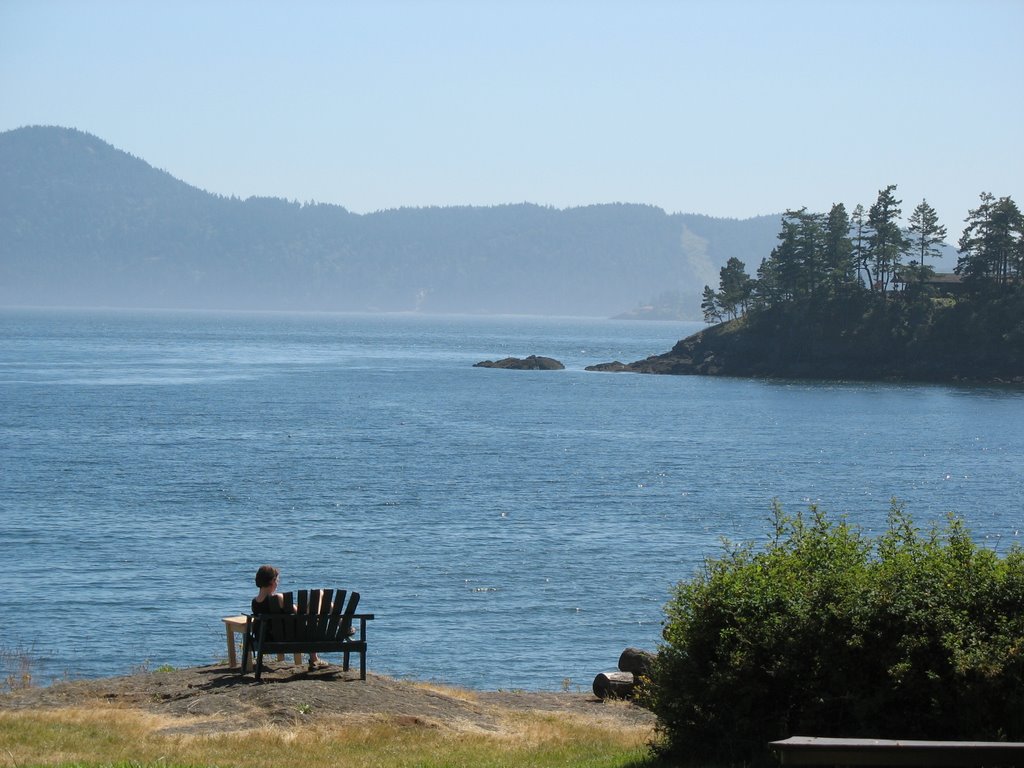
I am told that most Native American men of the Pacific Northwest nations went naked whenever they could. Apparently, given their hardy demeanor and the temperate climate, this was often. Surprisingly, however, such was not the custom for women. Despite their best efforts over the generations, the men simply could not convince the women to shed their garb and prance about naked collecting
salmon berries in the temperate rainforests. This particular problem, I found out, is virtually unknown to the modern-day menfolk at
Doe Bay Resort and Retreat on
Orcas Island.
The resort is primitive but splurges on the creature comforts. A sort of crunchy fine dining restaurant - "haute-hippie," if you will -- occupies a rustic wooden lodge perched above the bay. Nestled on a steep hill overlooking the bay are three slate-tiled hot tubs which look like something constructed by that civilization of furry
forest creatures in Star Wars. The area is designated as clothing optional and the designation seems to work (if only we had known in college that it was as simple as "designating" an area ...)
I don't know about you, but when I think clothing optional, I assume that the only people apt to exercise the option are those who -- at least according to our dubious cultural body ideals -- should not. Not so on our visit. Our stay coincided with a yoga retreat attended exclusively by very attractive and fit alternative professional types who, after a day of feeling great about themselves and their yoga practices, simply could not get their clothes off fast enough.
The thing about naked people is they are remarkably engaging conversationalists and fascinating to be around on a great many levels. Honestly -- and this will come as surprise to my readership -- I really don't see a great variety of naked women (or men, for that matter) on a regular basis. So in a way, it was not unlike a good birdwatching trip (you gotta admit its better than the zoo analogy). "Say ... look there... did you
know that the Purple Billed Tanager had such a
prominent tail feather ... make an entry on the life list honey ..."
A naked person, you see, takes a grave social risk when he exposes himself. When the anxious naked person is received by another in a socially appropriate manner (tip: eye contact only) an immediate bond of trust is formed. In the company naked people, the conversationalist wants desperately to avoid the most obvious conversation starters because, for example, "ouch sister! I bet that piercing HURT like the dickens" just doesn't seem appropriate. And so the conversations gravitate towards the abstract. It was thus that I found myself deep in conversation with two very naked European RNA scientists. I can tell you that my attention to the development of new computational tools in the field of bioinformatics was laser sharp -- it had to be -- for the alternative was to dwell on the more obvious matter at hand: "how in the world do shave in that spot -- seems a tough angle!" Truthfully, the conversation did degenerate once when someone from the resort approached the area and, pointing at a small boat adrift in the bay inquired: "Has anyone left their dinghy out?" Several gentlemen allowed that they had, indeed. In retrospect, I almost think this was intentional -- a sort of service the resort provides to entertain the guests. You can imagine the staff mixes it up from time to time: "excuse me people, but does anyone here have a small dinghy? No? A nice lady in a yacht in the bay called and she is very troubled by it ... "
Anyway, I've always found cocktail parties just a tad awkward but now I'm thinking if everyone would just take their clothes off it would be so much easier -- don't ya think? Probably a line the Pacific Northwest menfolk already tried, though.


 I don't have a picture but I laid sand on the concrete floor until it was flush with the two front concrete pavers. This picture shows the firebrick laid on top of the sand. I took some scrap bricks and laid them to the sides of the floor to keep things in place and to support the clay walls.
 We spent a surprisingly long time forming the sand mound. Kiko cautions that the form should rise very steeply and then round off gently at the top. For some reason, the temptation is to build a pointy form, which makes for a poorly shaped oven. He says to aspire to a pregnant belly shape, which is probably why it took me so long. Try though I did, my best effort was still a pretty scary looking pregnancy.

 After adding water and mixing with our feet, we formed wet bricks.


 Look how uneven my oven floor had become. The sand beneath the bricks sifted through the gravel bed and caused the floor to cave. This had been a constant headache for me in the early months after the oven build. I had to remove the bricks and relay gravel and sand, but it was impossible to make it level after the oven structure was in place. For the latter years of the oven, I lived with an uneven floor. Remarkably, it did not seem to matter as much as you might think. Nevertheless, I have vowed not to let this happen again. This time I w


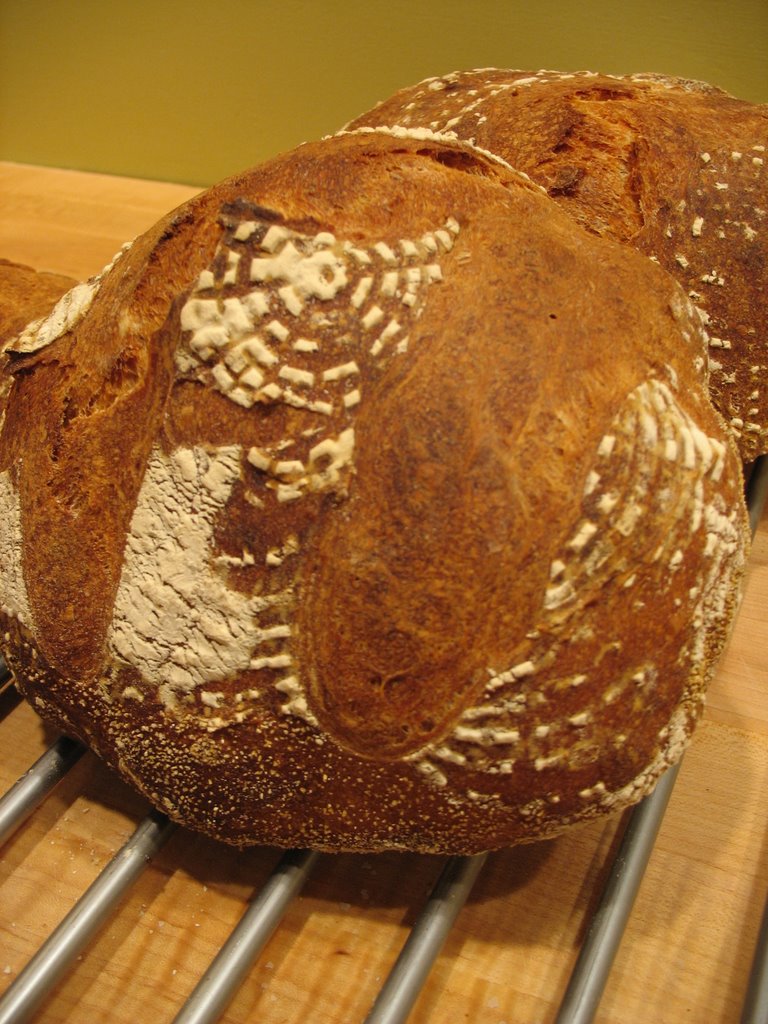
 Its an interesting observation, I think, that many of the foods about which we obsess the most involve a culture or a fermentation -- think wine, spirits, cheese (and sourdough). Part of it is the complexity of the resulting taste, but part of it also, I think, is primal. There is something darkly appealing about a delicious flavor that flirts with the taste of spoilage. How else can one account for the beloved french cheeses such as morbier, which have distinct overtones of toenail clippings and dead animals.
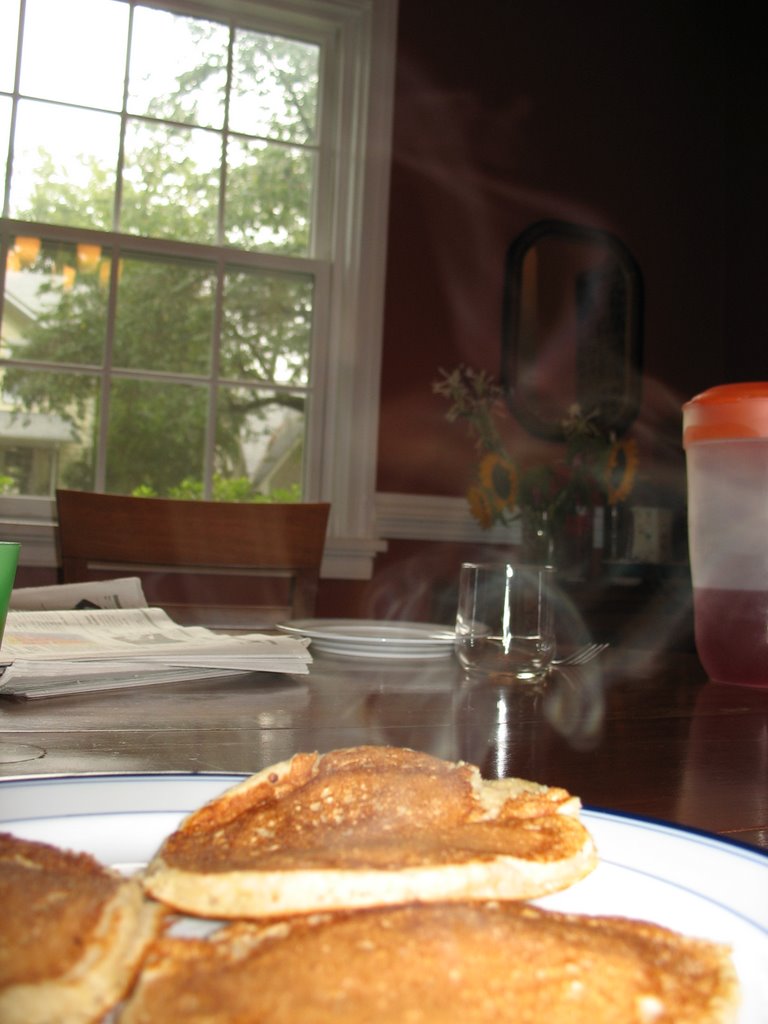
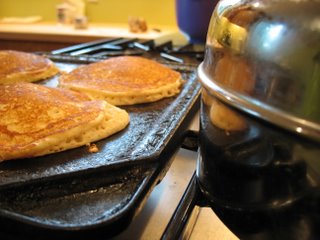 Honestly, now, consider the pancake. Humble but proud, the pancake was born of rustic griddles and coarse-milled grains but passes effortlessly into the uptight company of creme fraiche, fancy berries and bad coffee in silver service. When I was child, my mother made fine buttery pancakes on most weekend morns. So dedicated was my family, that when we were unable to acquire even imitation maple syrup in our home of central Africa, we made do with homemade sugar syrup flavored with maple extract. The 'cakes were still good.